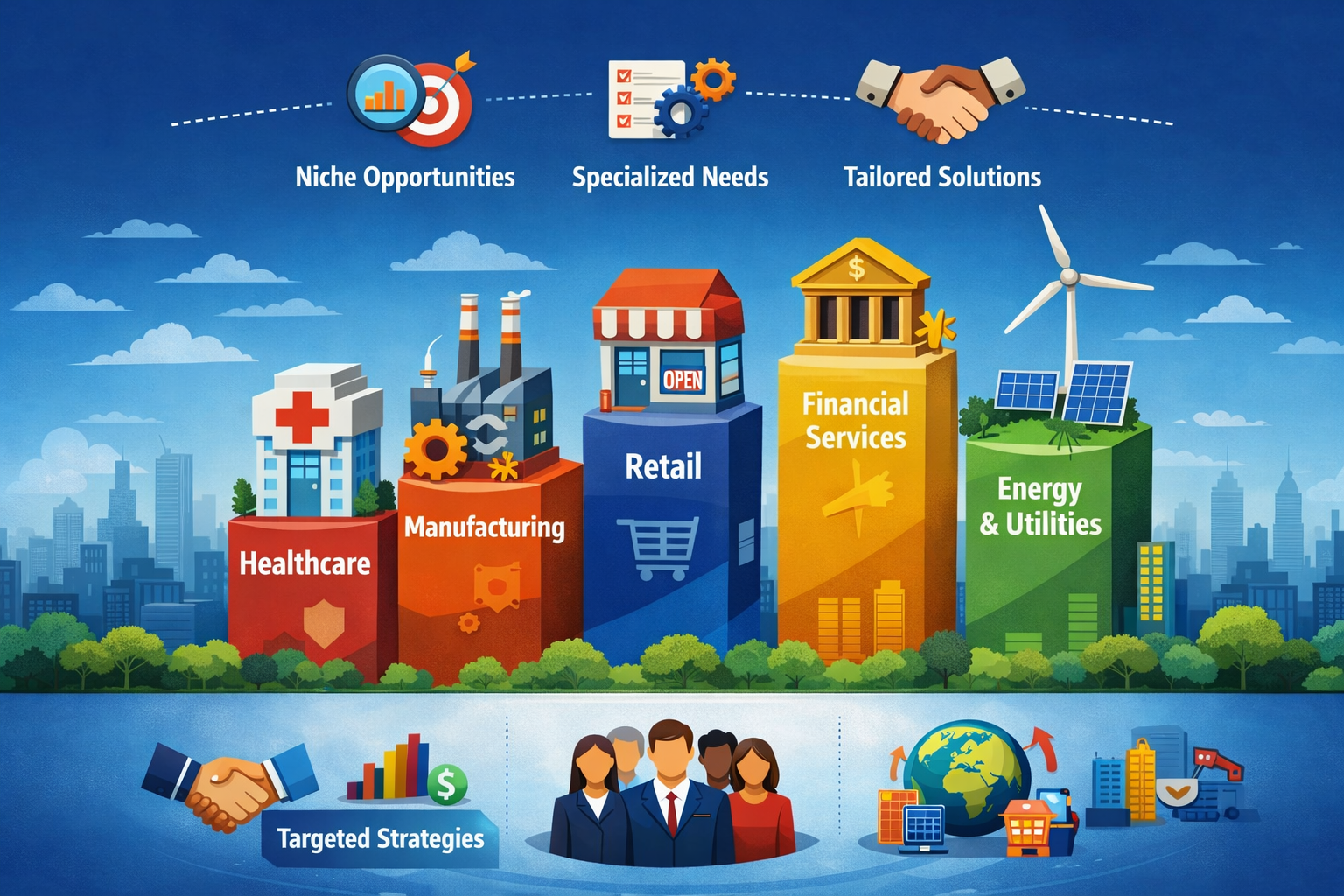
What is a vertical market?
A vertical market consists of companies that provide goods and services tailored to the needs of a specific industry or niche. These companies develop and market compatible products to a defined customer group.
Examples of broader vertical markets are insurance, real estate, banking, heavy manufacturing, retail, transportation, hospitals, and government. A financial application marketed to banks would be a product of such a vertical market.
Vertical markets may also target niche customer groups defined by specific demographics or narrow industry segments.
How do vertical markets work?
Vertical markets are categorized by the control of their distribution channels. Distribution channels are the organizations involved in delivering a product or service from the producer to the customer. The three main types are:
- Corporate vertical markets: In these markets, one organization owns all parts of the distribution channel, allowing complete control over the product or service.
- Administered vertical markets: Here, a dominant channel member is large enough to direct the activities of other members.
- Contractual vertical markets. These are vertical markets in which all companies in a distribution channel are independent and operate separately, yet they work together and form partnerships to be more efficient. Businesses may have contractual relationships with one another to make this possible. For example, producers and wholesalers might contract with distributors to serve specific markets.
Vertical markets often share similar regulatory compliance requirements. For example, healthcare providers and their suppliers must comply with regulations such as the Health Insurance Portability and Accountability Act and the Health Information Technology for Economic and Clinical Health Act to avoid penalties.
Advantages of a vertical market
Vertical markets and their associated relationships offer several benefits, including:
- Specialization: Targeting specific customer segments allows organizations to tailor products or services to precise customer needs.
- Higher value offerings: Companies can often charge premium prices for targeted or specialized products and services.
- Cost savings: Focusing marketing efforts on a defined customer group reduces operating expenses and enables more efficient resource use than broader marketing strategies.
- Reduced competition. Even though vertical markets are often less saturated with competitors than horizontal markets, competition may still exist. Markets do have some downsides, however. These include the following:
- Limited customer base: Serving a niche market can make it challenging to find and grow customers.
- Limited revenue: A small customer base may make it difficult to generate sufficient revenue and profit.
- Niche-market shifts: Sudden changes in customer needs can lead to significant customer losses. For example, restaurant and bar closures during the COVID-19 pandemic illustrate this risk.
Vertical market vs. horizontal market
Horizontal markets are diversified, offering products and services that meet the needs of multiple industries and a broad customer base. The products could include office productivity applications and databases marketed to a variety of industries. Horizontal marketing comes with its own set of challenges. Marketers must emphasize the product’s generic aspects that work well for everyone.
In contrast, vertical-market products and services target specific businesses within a single industry. Marketing strategies are often easier to develop due to a smaller, more homogeneous audience.
Descriptions and examples of vertical and horizontal markets.
Vertical marketing strategy
Vertical marketing is essential for many IT channel companies. Value-added resellers and managed service providers often specialize in one or more verticals.
These companies build expertise in their chosen verticals by understanding customer needs, business models, challenges, and key market trends and terminology.
They also tailor marketing plans and solutions to fit the needs of their target customers.
In fine-tuning a vertical-market strategy, an organization must identify and focus on its target market and establish clear criteria for the vertical. It should also understand:ties customers have to each other;
- preferred product types or formats; and
- the most effective marketing approaches.
Examples of vertical markets
Some specific vertical markets include the following:
Law firms: Attorneys often need specialized document management applications and have higher printing volumes than other businesses, making them a good fit for managed printing solutions.
Grocers: While grocery stores belong to the broader retail vertical, some focus on niche markets. For example, Whole Foods Market targets customers seeking organic products. Distributors of organic and environmentally friendly goods often target such grocers. Farm. One, for instance, grows produce for Whole Foods Market on a vertical farm.
Retailers: All retail shops require point-of-sale (POS) systems, but POS vendors often tailor their solutions to specific niches. For example, a clothing store’s POS system differs from that of a supermarket.