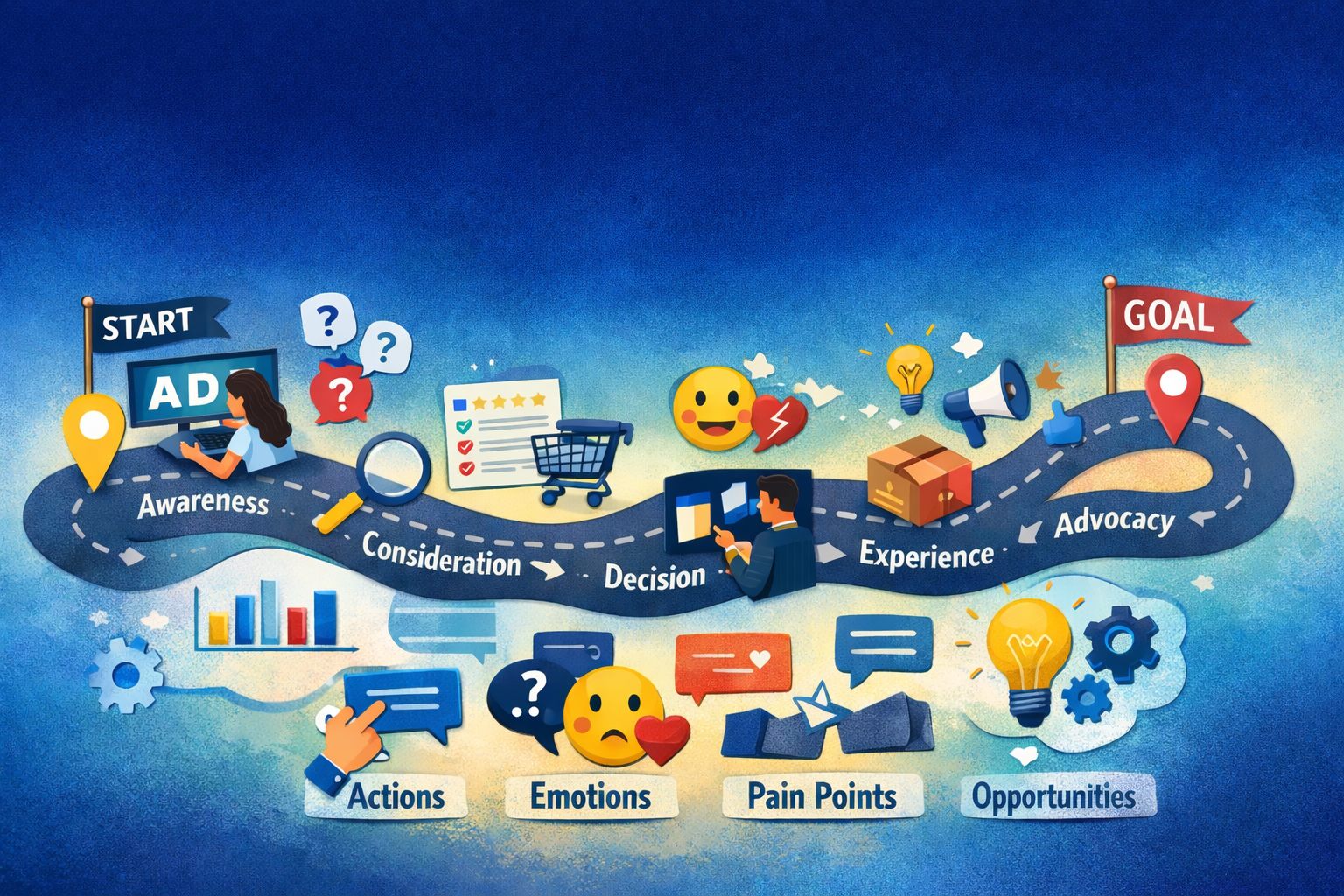
A customer journey map visually illustrates how individuals interact with your brand, from recognizing a need to purchasing, using, and recommending your offering. Its value goes beyond listing steps such as “visited website” or “bought product.” An effective journey map uncovers the reasons behind customer decisions, including their goals, concerns, obstacles, and motivations.
It also clarifies a common misconception: the buyer’s journey is the general process people follow (awareness, consideration, decision), while the customer journey is the specific path through your business, including ads, landing pages, emails, pricing, checkout, and support. Mapping this specific experience enables actionable improvements.
Why Journey Mapping Changes Business Results
Customer journeys are rarely linear. People move between channels, compare competitors, read reviews, abandon carts, return later, and ask last-minute questions. Each interaction, or “touchpoint,” influences their trust and progress. Journey mapping enables teams to design experiences intentionally, reducing friction, increasing conversions, and improving retention and loyalty.
When you map the journey well, you can see:
- Where people drop off and what triggers it
- Which moments create confidence (or doubt)
- What customers need at each stage vs. what your business is pushing
- Which improvements will have the biggest impact, fastest
The Building Blocks of a Customer Journey Map
A practical journey map typically includes five core layers. Together, these layers turn the map into a decision-making tool rather than a simple diagram.
The journey stages
This is the foundation of the map: the main phases a customer moves through. Many teams begin with Awareness, Consideration, and Decision, then add Experience (use or onboarding) and Advocacy (renewals, referrals, reviews). The most effective stage model reflects actual customer behavior in your business.
Touchpoints
Touchpoints are all moments when a customer interacts with your business, including ads, social posts, landing pages, product pages, emails, checkout, confirmation messages, support chats, review sites, shipping, and delivery. Any interaction that can influence perception should be included on the map.
Customer actions
Customer actions at each stage include searching for keywords, reading comparisons, revisiting pricing pages, watching demos, signing up for trials, abandoning carts, and contacting support. These actions reveal effort and intent, and often indicate hidden friction.
Emotions and mindset
Many teams overlook this element, yet it often distinguishes a visually appealing map from a practical one. Customers experience uncertainty, urgency, excitement, skepticism, relief, and frustration. Mapping emotional highs and lows helps prioritize which issues to address first, focusing on moments where friction is most costly.
Opportunities and solutions
A journey map should drive action. For each pain point identified, document a corresponding improvement, such as simplifying checkout, adding payment options, reducing load times, clarifying copy, enhancing FAQs, improving onboarding emails, adding trust signals, or refining support workflows. This approach transforms insights into a clear roadmap.
The Data You Need to Map Reality (Not Assumptions)
Journey maps are ineffective when based solely on internal opinions. The most valuable maps rely on two complementary types of data:
What customers tell you (solicited data)
This includes surveys, interviews, NPS or CSAT feedback, and direct questions about what influenced their decisions. The focus should be on understanding feelings and friction, not just actions, to uncover what built confidence or caused hesitation.
Ways to strengthen solicited data:
- Interview recent buyers and ask what almost stopped them
- Survey people who didn’t buy and ask where the experience broke down
- Add “why” questions to post-purchase surveys (confidence drivers, confusion points)
- Use short polls for fast directional signals, then validate with interviews
What customers do (unsolicited data)
This refers to behavioral data, including page paths, bounce rates, scroll depth, checkout drop-off, email opens and clicks, support logs, ticket resolution times, and reviews or social mentions. It reveals what customers do at scale, even when they do not or cannot express it directly.
The best insight often comes from combining both:
- An interview says “I loved it,” but analytics show repeat pricing-page visits → something still felt unclear
- CSAT is high, but resolution times are long → the service feels slow even if agents are kind
- People praise the product, but abandon it at shipping → pricing transparency is the real problem
How to Create a Customer Journey Map That Your Team Will Use
Start with a clear objective
Define the specific question your map must answer. Examples:
- Why are customers abandoning carts at checkout?
- Why do trial users fail to activate in the first week?
- What’s preventing renewals at month six?
- Which steps create the most uncertainty before purchase?
A focused map drives focused action.
Choose one persona, one scenario
A journey map should focus on a specific customer type with a defined goal. Attempting to map all customers creates unnecessary complexity. Begin with the most common or highest-value persona and one scenario, such as first purchase, onboarding, cancellation, or upgrade. Expand to other scenarios as needed.
Inventory your touchpoints across channels
Brainstorm every interaction customers might have across:
- Search and content
- Paid ads and social
- Landing pages and product pages
- Email flows (welcome, nurture, cart recovery, onboarding)
- Sales calls or demos (if applicable)
- Support and self-service
- Post-purchase experience (delivery, setup, returns)
Next, validate this list with analytics and actual customer feedback.
Walk the journey yourself
Experience the process from a customer’s perspective by searching keywords, clicking ads, signing up, attempting checkout, opening emails, and contacting support. This empathy audit uncovers subtle issues that data alone may not reveal, such as confusing copy, slow pages, lack of reassurance, or unclear next steps.
Analyze patterns and identify bottlenecks
Look for:
- Drop-off points (where journeys end)
- Rework loops (where customers repeat actions like revisiting pricing)
- Friction (confusing navigation, too many steps, lack of trust)
- Emotional dips (moments of doubt or frustration)
- Bright spots (touchpoints that create confidence or delight)
Convert each insight into a prioritized action item.
Treat the map as a living document
Customer behavior evolves with product updates, competitive changes, pricing adjustments, and market shifts. Review your journey map monthly or quarterly, and update it after major launches or changes to your sales funnel.
Four Journey Map Types and When to Use Them
Current-state journey map
Shows what customers experience today—best for finding friction and quick wins.
Day-in-the-life map
Shows what customers do in their broader daily reality (with or without your product)—best for uncovering unmet needs and new positioning opportunities.
Future-state journey map
Designs the ideal experience you want to deliver—best for aligning teams around a vision and planning improvements.
Service blueprint
Adds “backstage” operations (people, processes, systems, policies) that create the experience—best when you need to fix root causes, not just surface symptoms.
Best Practices That Make Journey Maps More Powerful
Use customer language, not internal jargon
Develop a language bank from reviews, chats, calls, and social mentions. Use this language in your pages, emails, and user interface to reduce friction and help customers feel understood.
Map both experience and effort
If customers encounter excessive effort, such as too many clicks, form fields, or decisions, it often results in repeated actions, long sessions, and drop-offs. Measure both effort and satisfaction.
Design for confidence at key moments
Most conversions fail not due to a single major issue, but because confidence was not built consistently. Provide reassurance at key moments:
- Before pricing (value clarity)
- At pricing (what’s included, comparison, FAQs)
- At checkout (security, refunds, delivery costs, payment options)
- After purchase (confirmation, next steps, support access)
Align owners to touchpoints
A journey map becomes actionable when each touchpoint has a designated owner, such as marketing, product, sales, or support, and every pain point is tracked as an improvement with a set deadline.
Common Friction Points and Practical Fixes
Checkout abandonment
Common causes include hidden costs, limited payment methods, slow page load times, confusing forms, and weak trust signals. Solutions include providing transparent pricing earlier, improving load times, simplifying forms, offering guest checkout, adding multiple payment options, displaying a clear returns policy, and highlighting security features.
“Interested but not buying”
Common causes include unclear differentiation, insufficient proof, pricing confusion, lack of urgency, and a mismatch between ad promises and landing pages. Solutions involve stronger positioning, clearer audience targeting, improved comparison content, more reviews or case studies, consistent messaging, and risk reversal through trials or guarantees.
Early churn after purchase
Common causes include weak onboarding, unclear value realization, support delays, and product complexity. Solutions include guided onboarding, milestone emails, in-product checklists, proactive support, and a straightforward path to initial success.
Turning Your Journey Map Into a Growth Engine
A journey map delivers value when it informs decision-making:
- Use it to prioritize experiments (A/B tests, UX changes, email sequence improvements)
- Use it to align teams on what customers actually experience
- Use it to measure progress (drop-off rates, time-to-first-value, satisfaction, retention)
- Use it to identify “moments that matter” and design them intentionally
When your map accurately reflects customer actions and emotions, you gain a reliable method to reduce friction, build trust, and improve the end-to-end experience.